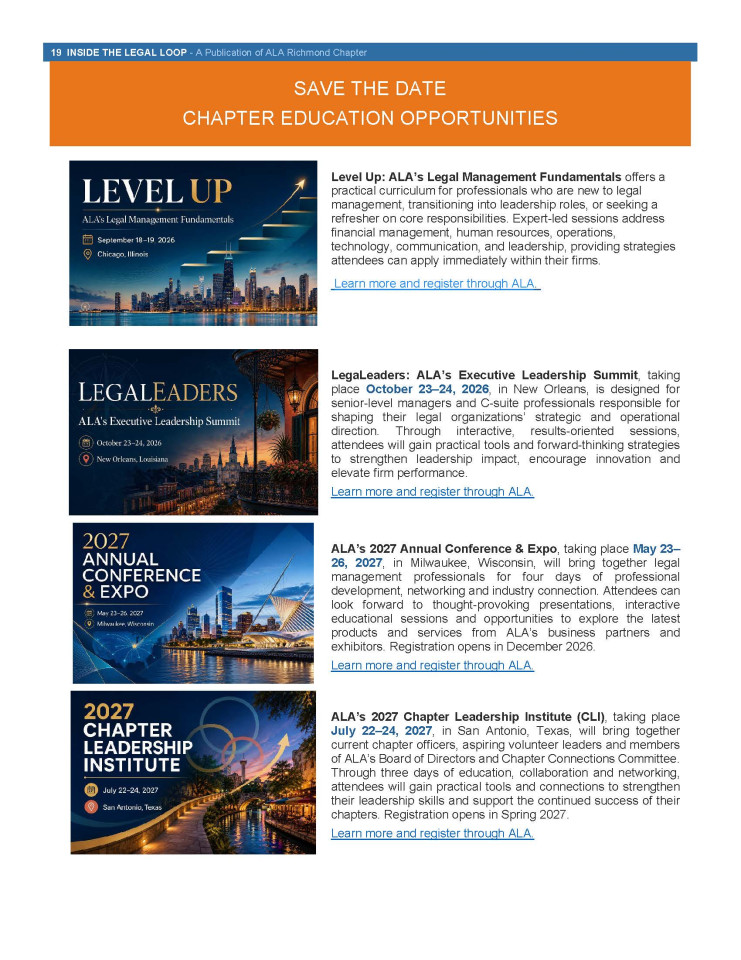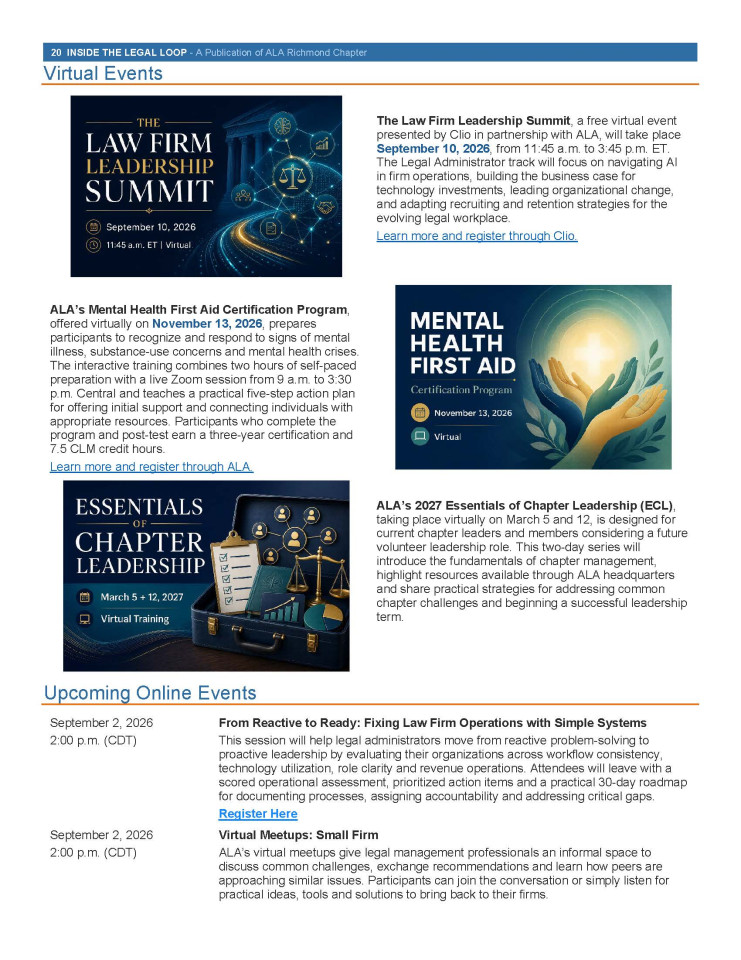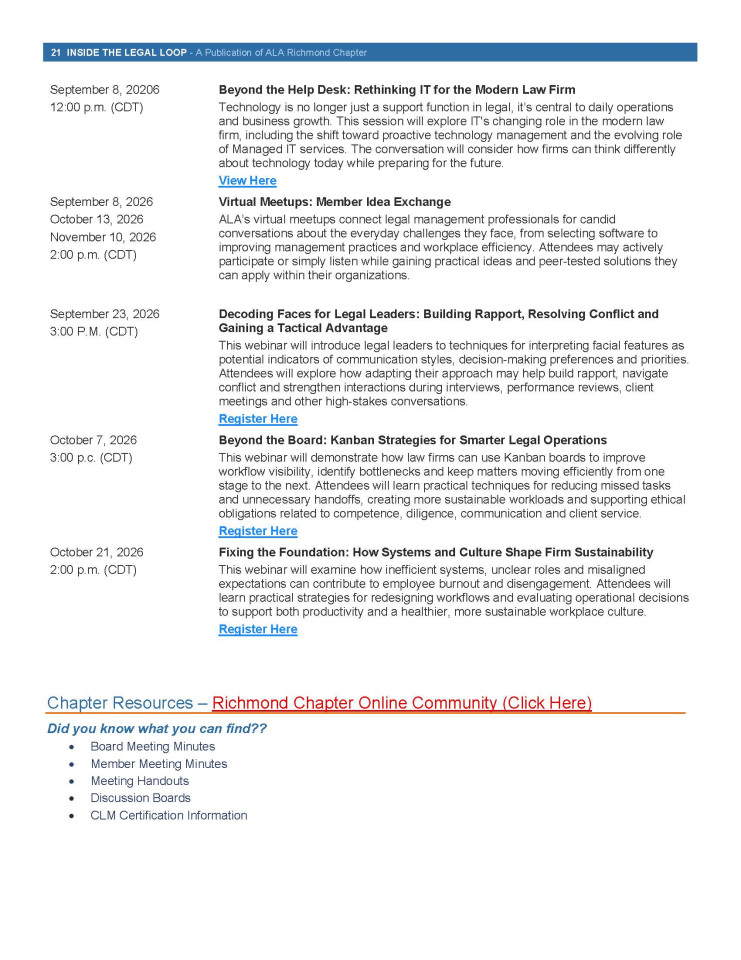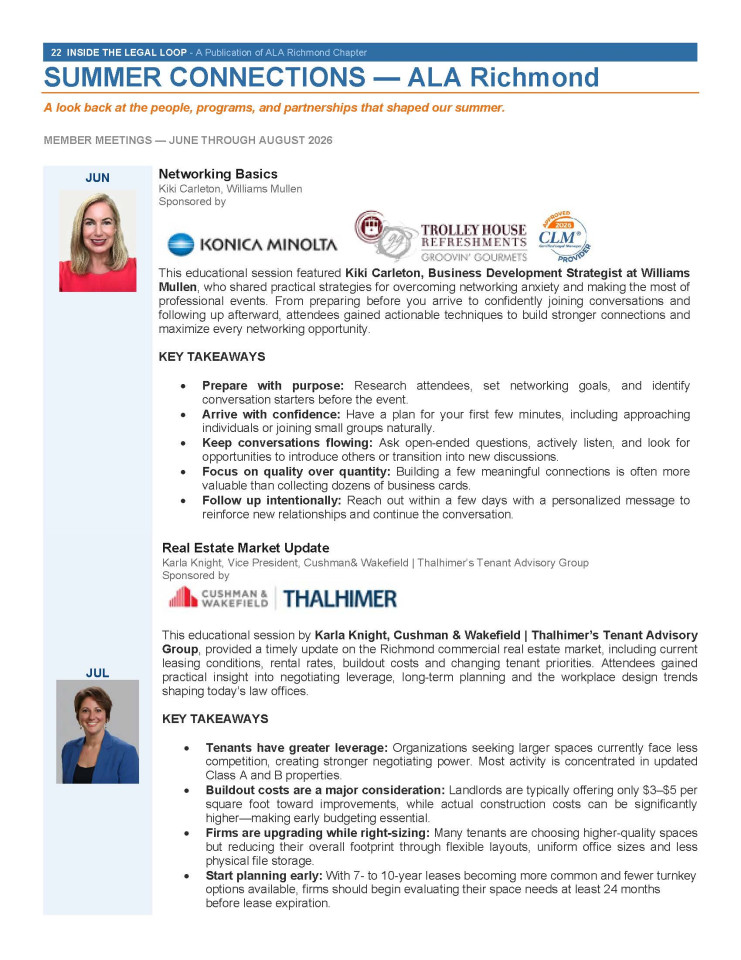

June 2026 Newsletter Print

Cover Page

A MidYear SnapShot - All Things ALA

Editors

Danielle Dann

Robin Ruleman

If you have suggestions or content for future editions, please reach out to Danielle Dann, Communications Committee at [email protected] or Robin Ruleman at [email protected].


Back to top

Welcome Message

Welcome to the Inaugural Edition of Inside the Legal Loop, the official newsletter of the Richmond Chapter of the Association of Legal Administrators.

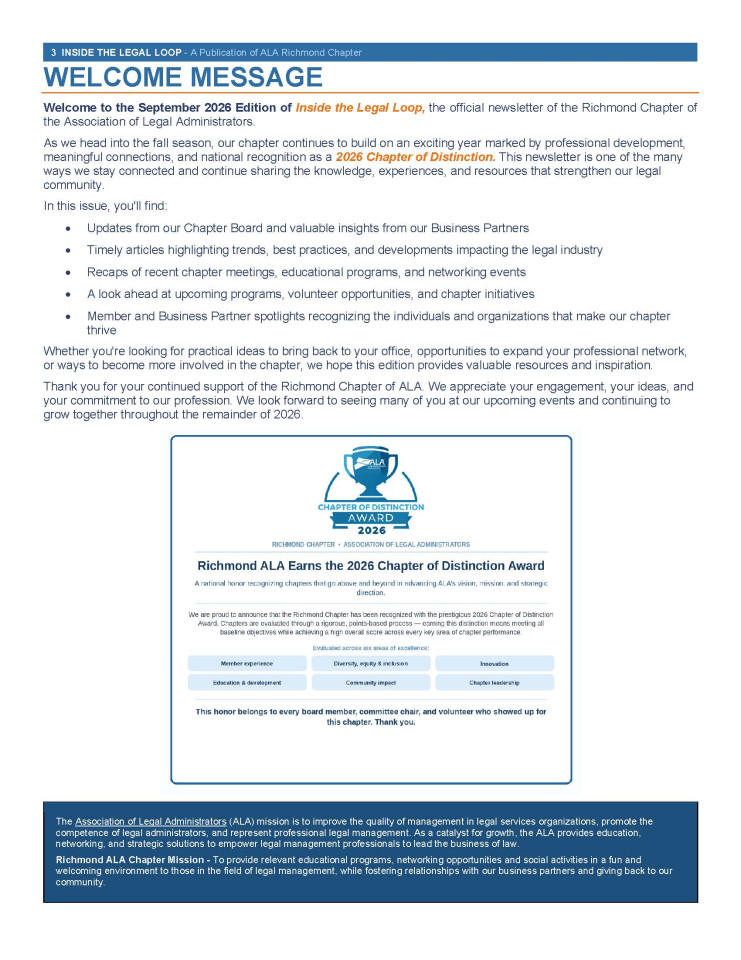
This year, the Richmond Chapter earned national recognition as a 2026 Chapter of Distinction — and this newsletter is one more way we're building on that momentum.

We're excited to launch this new quarterly publication as a way to keep our members and business partners informed, connected, and engaged.

As our inaugural issue, this edition offers a special midyear look back at the first six months of 2026 — highlighting the people, programs, and progress that continue to shape our chapter.

Inside, you'll find:

  • Updates from our Board and valuable insights from our Business Partners
  • Timely articles focused on trends and developments impacting the legal industry.
  • Recaps of recent member meetings and chapter events
  • A preview of upcoming educational programs and opportunities
  • Member and Business Partner spotlights recognizing the individuals who strengthen our community.

Our goal with Inside the Legal Loop is simple: to provide meaningful, relevant content that supports your professional growth while showcasing the strength of our Richmond ALA network.

Thank you for being part of our chapter and for contributing to its continued success. We look forward to growing this publication with you. Stay connected—and enjoy the first issue!


The Association of Legal Administrators (ALA) mission is to improve the quality of management in legal services organizations, promote the competence of legal administrators, and represent professional legal management. As a catalyst for growth, the ALA provides education, networking, and strategic solutions to empower legal management professionals to lead the business of law.

Richmond ALA Chapter Mission - To provide relevant educational programs, networking opportunities and social activities in a fun and welcoming environment to those in the field of legal management, while fostering relationships with our business partners and giving back to our community.


Back to top

President's Report

Billie Jo Brooks is no stranger to Williams Mullen or to the Richmond legal community. As Chief Administrative Officer at the full-service Richmond firm, she keeps the engine running across office administration, information technology, facilities, and research services — working shoulder-to-shoulder with firm leadership to make sure operations support the bigger picture.

What makes Billie Jo's leadership stand out isn't just her 25+ years at Williams Mullen — it's what she's done with that time. She has held multiple leadership roles within the firm, and her hands-on knowledge of how the organization works has driven real improvements in how it operates day to day.

Beyond Williams Mullen, Billie Jo has been an active voice in the broader legal management world, lending her time and expertise to the Association of Legal Administrators, the International Legal Technology Association, and the Virginia Association of Law Libraries. She's not new to the Richmond Chapter, either — she has served in multiple roles before stepping into her current position.

Now, as our newly elected President for the 2026–2028 term, she brings all of that experience home — and we're glad to have her leading the chapter.

A Message From Billie Jo:

The Power of Curiosity in Driving Growth


In law firms, growth is often measured by revenue, headcount, or new practice areas. But one of the most powerful—and often overlooked—drivers of growth is curiosity.


Curiosity is a discipline. It’s the habit of asking, “Why do we do it this way?” Many processes exist because they always have, not because they’re the most effective. When we pause to question them, we uncover opportunities to improve efficiency, eliminate redundancies, and better serve our clients.


As legal administrators, we have a unique view across operations, technology, and people. We see how work actually happens, which puts us in a position to challenge inefficiencies. Too often, processes continue simply because they are familiar. Curiosity is what disrupts that cycle and creates momentum for improvement.

Curiosity also grows when we learn from others. Attending member meetings is one of the easiest and most valuable ways to do that. Hearing how other firms approach similar challenges often sparks new ideas and encourages us to rethink our own practices. Sometimes one shared experience or question can lead to meaningful change back at our firms.


Just as important, curiosity creates a culture of learning. When we ask questions, we invite others to think differently and contribute their perspectives. That’s how innovation takes hold.

The greatest risk to growth is complacency. When we stop asking questions, we stop evolving.


Stay curious. Ask questions. Show up and learn from each other—because that’s where real growth begins.


Back to top

A Note of Gratitude - Thank You, Christine Purgason!

Leadership transitions are a natural part of any organization, but that doesn't make it any easier to say thank you to someone who has given so much.

Christine Purgason brought something special to her time as President of the Richmond Chapter — a steady hand, a collaborative spirit, and a genuine commitment to the people in this room. Whether she was working to strengthen relationships with our business partners, driving member engagement, or simply showing up and leading by example, Christine approached every aspect of the role with the same focus and care she brings to her work at Williams Mullen every day.

Under her leadership, our chapter grew — not just in activity, but in connection. The partnerships we've built, the momentum we're carrying into this new term, and the strong foundation that made our 2026 Chapter of Distinction Award possible all reflect the work she put in.

We are fortunate that Christine isn't going far. As our Immediate Past President, she remains a valuable voice and a trusted resource for our chapter's leadership — and frankly, we're counting on it.

Please join us in thanking Christine for her service, her dedication, and everything she has poured into this chapter. The Richmond ALA community is stronger for it.

— ALA Richmond Chapter


Back to top

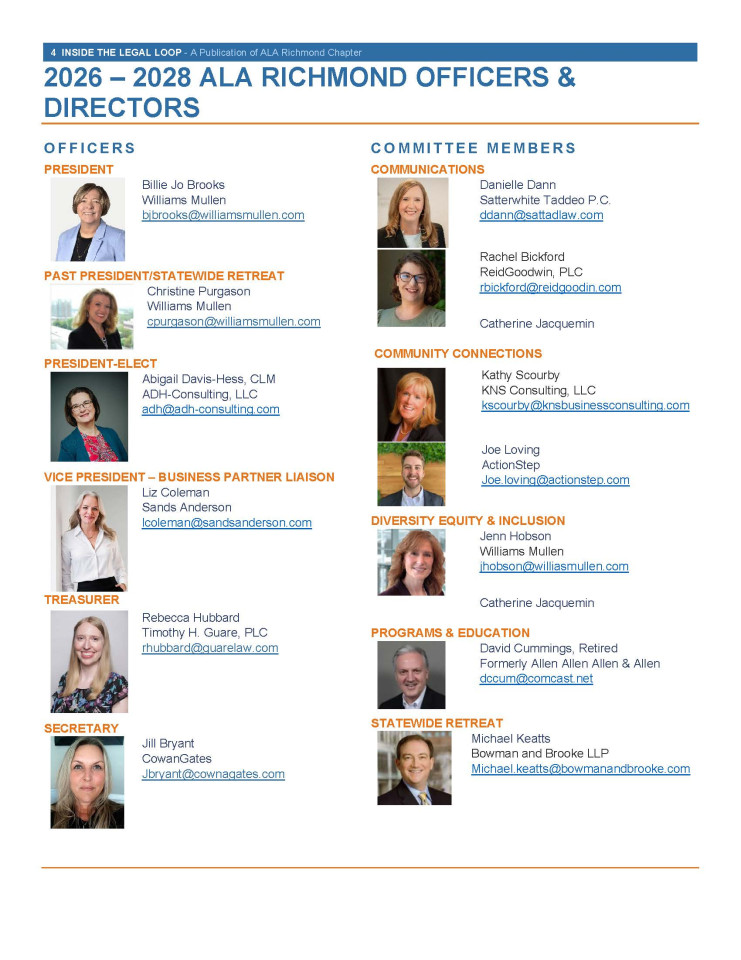
RALA Board & Committee Members


OFFICERS

PRESIDENT

Billie Jo Brooks

Williams Mullen

[email protected]

PAST PRESIDENT/STATEWIDE RETREAT

Christine Purgason

Williams Mullen

[email protected]

PRESIDENT-ELECT

Abigail Davis-Hess, CLM

ADH-Consulting, LLC

[email protected]

VICE PRESIDENT – BUSINESS PARTNER LIAISON

Liz Coleman

Sands Anderson

[email protected]

TREASURER

Rebecca Hubbard

Timothy H. Guare, PLC

[email protected]

SECRETARY

Jill Bryant

CowanGates

[email protected]


COMMITTEE MEMBERS

COMMUNICATIONS

Danielle Dann

Satterwhite Taddeo P.C.

[email protected]

Rachel Bickford

ReidGoodwin, PLC

[email protected]

Catherine Jacquemin

COMMUNITY CONNECTIONS

Kathy Scourby

KNS Consulting, LLC

[email protected]

Joe Loving

ActionStep

[email protected]

DIVERSITY EQUITY & INCLUSION

Jenn Hobson

Williams Mullen

[email protected]

Catherine Jacquemin

PROGRAMS & EDUCATION

David Cummings, Retired

Formerly Allen Allen Allen & Allen

[email protected]

STATEWIDE RETREAT

Michael Keatts

Bowman and Brooke LLP
[email protected]


Back to top

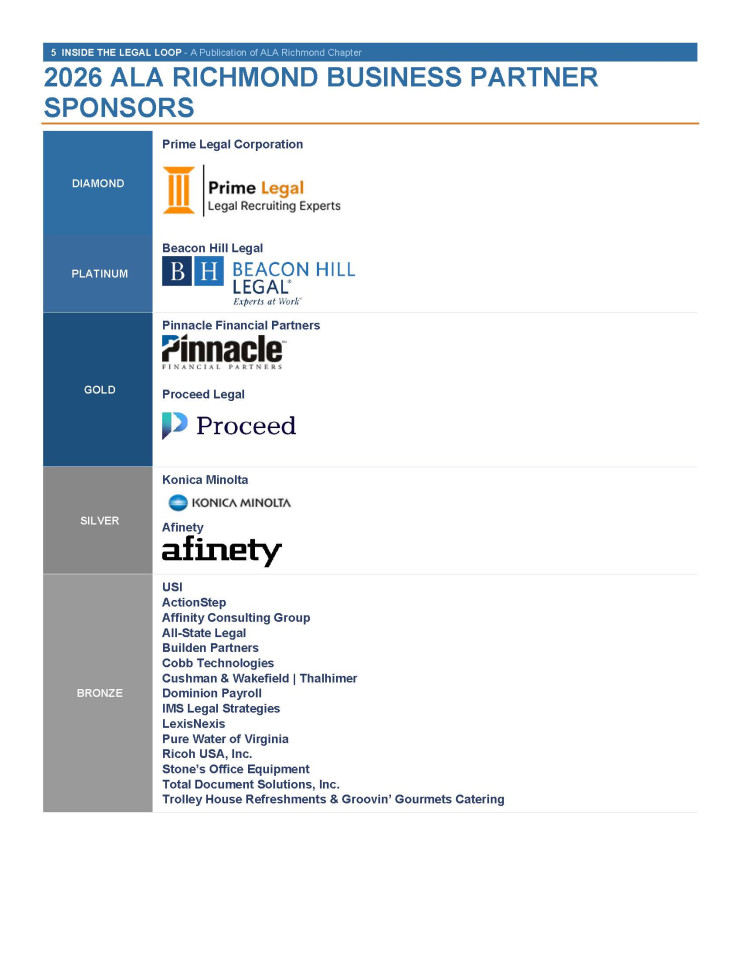
RALA Business Partner Sponsors

♦ DIAMOND

Prime Legal Corporation

♦ PLATINUM

Beacon Hill Legal

♦ GOLD

Pinnacle

♦ SILVER

Konica Minolta

Afinety

♦ BRONZE

USI

ActionStep

Affinity Consulting Group

All-State Legal

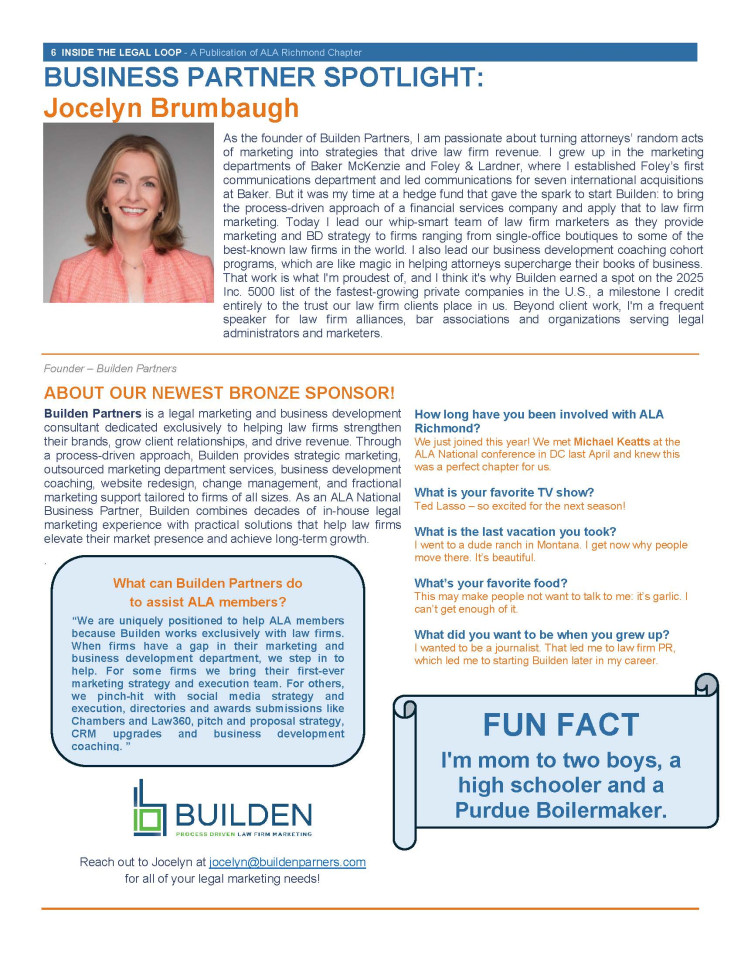
Builden Partners

Cobb Technologies

Cushman & Wakefield | Thalhimer

Dominion Payroll

IMS Legal Strategies

LexisNexis

Pure Water of Virginia

Ricoh USA, Inc.

Stone’s Office Equipment

Total Document Solutions, Inc.

Trolley House Refreshments & Groovin’ Gourmets Catering

Back to top

DIAMOND BUSINESS PARTNER SPOTLIGHT: Christine Tommasino


Vice President - Legal  Support Practice Leader –
Legal Staff Recruitment

As the Head of Legal Staff Recruitment at Prime Legal, I lead a full-service, legal-specific recruiting team that supports professional staff needs at all levels. From paralegals and legal assistants to firm executive leadership, as well as specialized roles in finance, billing, IT, and marketing, I’m dedicated to identifying the right talent for law firms across the Mid-Atlantic, Southeast, and beyond. My goal is to provide the highest level of service - offering valuable insight into each candidate’s capabilities to help clients make informed hiring decisions. I’m heading into my eighth year with Prime Legal and have spent that time focused on developing an expansive network of legal professional connections. This experience gives me a unique perspective on the markets we serve and allows me to better identify candidates who are truly qualified for specialized needs! I grew up in Newport News, VA, and moved to Richmond in 2011 to attend Virginia Commonwealth University, graduating in 2015. In 2022, I joined as an instructor for VCU’s Continuing & Professional Education Paralegal Certificate Program, where I lead the Career Preparation course. I built the curriculum around what I’ve learned working with law firms - what they look for in candidates and how students can best position themselves for success in the legal field.

ABOUT OUR DIAMOND SPONSOR!

Prime Legal provides the legal staff to drive your organization and the career opportunities to grow your legal career.
Their knowledge, experience, and affiliation with The Richmond Group USA, a top national search firm with 55+ years of success, provides an unmatched ability to recruit successfully based upon the specific needs of our clients and candidates. Prime Legal is one of the few firms that possess a track record of success as well as great knowledge and understanding within the legal community.


Reach out to Christine at [email protected] 
for all of your staffing needs!

How long have you been involved with ALA Richmond?
I joined Prime Legal in 2019 and attended my first ALA meeting in the fall!
What is your favorite TV show?
Parks and Recreation!
What is the last vacation you took?
We went to the Dominican Republic in February!
What’s your favorite food?
Does chocolate count?!?"
At what age did you become an adult (in your opinion)?
Around 26! I’d always heard that your frontal lobe develops around that age and never thought much of it - until I hit 25/26 myself. A lot changed that year (including my career!), and each of those changes was for the absolute best.
Where would you go if you could go anywhere (if money or time were not an option)?
A long European adventure, starting in Naples, Italy—where I still have some very extended family members—then up through Northern Italy, into Switzerland, over to Paris, through Belgium and the Netherlands, and finally on to Copenhagen, Denmark!


Back to top

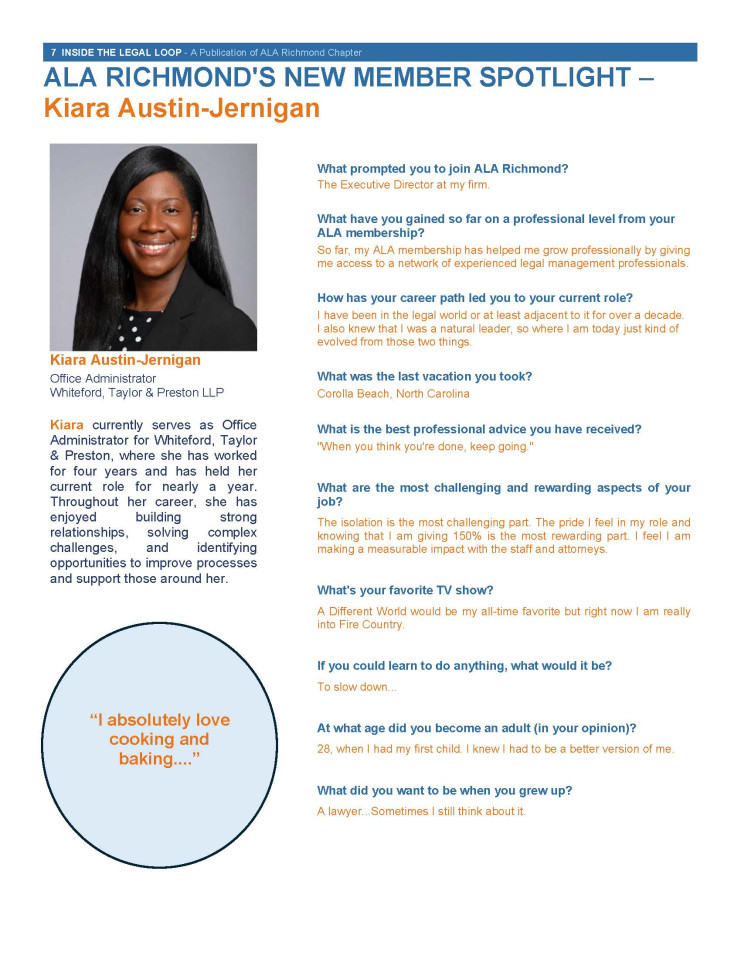
New Member Spotlight - Christine Milburn


Associate Firm Administrator
ADH-Consulting, LLC

As an Associate Fractional Law Firm Administrator with ADH Consulting, Christine partners with solo and small law firms to bring greater structure and efficiency to their operations. Her background includes building and scaling a law firm’s sales department, where she introduced systems that improved consistency and accelerated growth. She is especially passionate about helping business owners move from overwhelm to clarity by creating systems that make their firms run more smoothly and successfully.


What prompted you to join ALA Richmond?

Professional development has always been important to me, especially the opportunity to learn from others’ experiences, both their successes and their challenges. I also value connecting with like-minded legal professionals, particularly in administrative and operational roles where that kind of peer support isn’t always readily available.

hat have you gained so far on a professional level from your ALA membership?

So far, I’ve really gained insight from the experiences of others. Hearing about both the successes and challenges that others have faced has helped me expand my own knowledge base and, in some cases, has influenced how I think about approaching future projects. It’s been incredibly valuable to learn from a variety of perspectives and apply those lessons to my own work.

How has your career path led you to your current role?

I’ve always been driven to carve my own path professionally. While I was naturally drawn to the legal field through coursework in business law, communications law, and philosophy, becoming an attorney was never my goal—business and operations have always been my strength. I began my career at the front desk of a law firm, where I focused on continuously improving processes and finding ways to better support the team. That mindset led me into an intake/sales role, where I became the firm’s first dedicated intake specialist and built the department from the ground up by setting goals, creating systems, and refining processes. I found that I truly enjoy creating structures and seeing how thoughtful changes can improve outcomes. That drive to keep growing and improving ultimately led me to ADH Consulting, where I now have the opportunity to expand my knowledge across all areas of a law firm while helping others strengthen their operations and achieve their goals.

 What was the last vacation you took?

The last vacation I took was over spring break with my children. I grew up in the Philadelphia area but now live in Richmond with my husband and kids, so I enjoy taking them back to Pennsylvania each year to visit family and explore the museums and places I grew up with. It’s special to be able to experience those things again through their eyes and share those memories with them.

What is the best professional advice you have received?
The best professional advice I’ve received came from a manager while I was navigating a challenging situation with a team member. I was concerned about their lack of response to feedback and whether they truly agreed with the changes I was asking for. My manager told me, “It doesn’t matter if they agree or disagree with your feedback—what matters is whether you see a change.” That advice has stayed with me because it applies to so many professional relationships and has helped me focus on outcomes rather than getting caught up in reactions.


Back to top

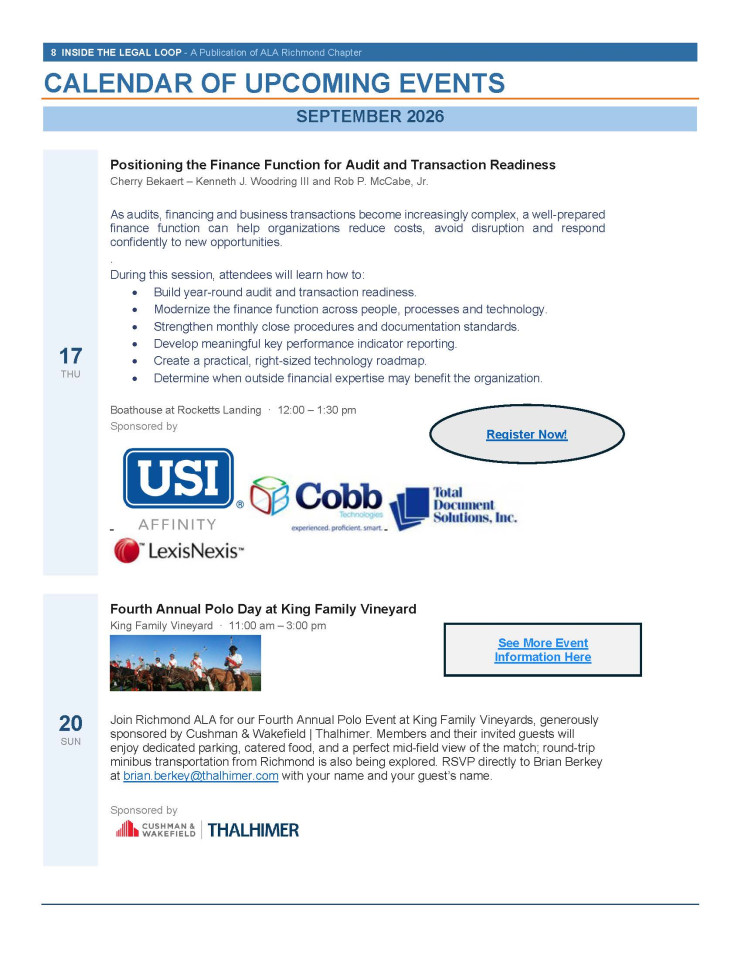
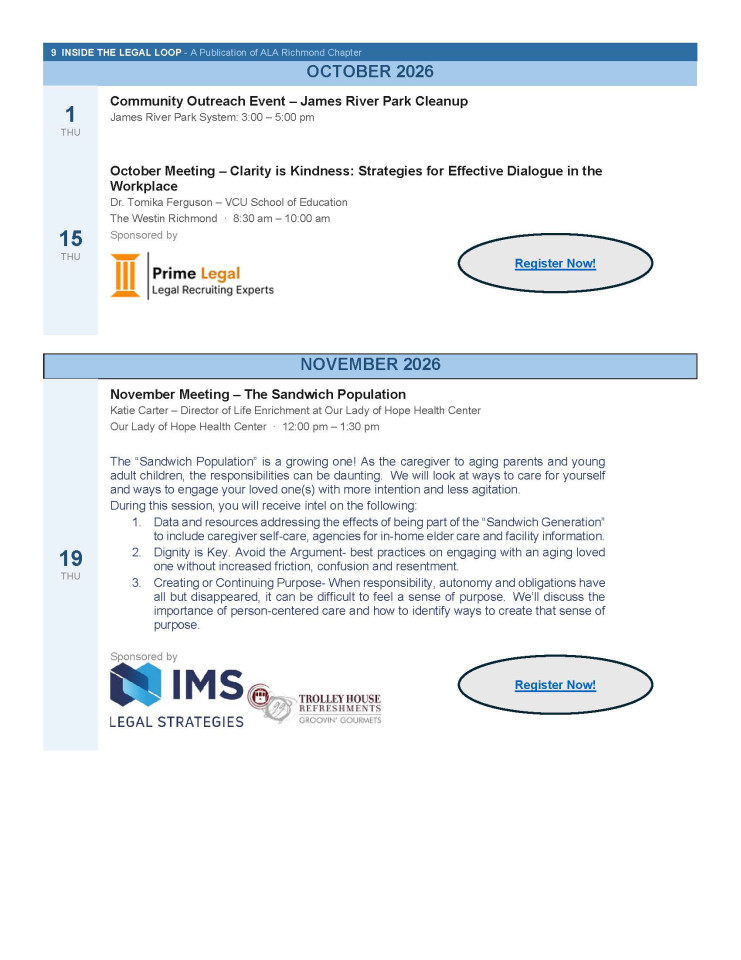
Calendar of Events


JUNE 2026

17
WED

Member Meeting – Networking Basics

“How to Make Your Next Networking Event Your

Best Networking Event!”

Have you ever seen an event that looked interesting, so you decided to register for it, but paused because you weren’t sure you’d know anyone? If you responded yes, this program is for you! The presenter, Kiki Carleton, Business Development Strategist (non-attorney) at Williams Mullen, will describe specific steps you can take before events to increase your comfort level and effectiveness. She will also provide suggestions on what to do right after you arrive—which for some can be the most challenging part—and how to pivot to additional conversations. Finally, she’ll share some thoughts on how to follow up after events.


CLM® Application Credit: 1 hour(s) in Communication Skills.
CLM® Recertification Credit: 1 hour(s) in Communication and Organizational Management.


Stock Bar  ·  12:00 – 1:30 pm

Sponsored by 

REGISTER NOW!!!

25
WED

Summer Happy Hour at BLUE BEE CIDER

Join fellow RALA members for an evening of networking and connection at Blue Bee Cider, Richmond’s beloved urban cidery known for its handcrafted ciders and inviting taproom atmosphere. Enjoy great conversation, local flavors, and a relaxed setting while connecting with industry peers and expanding your professional network. It’s the perfect opportunity to unwind, make new connections, and experience one of RVA’s unique local gems.


Blue Bee Cider · 5:30 pm

Sponsored by  Builden Partners


REGISTER NOW!


JULY 2026

14
TUE

Member Meeting (Hybrid) – Economic Update

Karla Knight, First Vice President of Cushman & Wakefield | Thalhimer’s Tenant Advisory Group will present on real estate market trends impacting the legal industry and share an update on the Richmond Office Market.


Thalhimer  ·  12:00 – 1:30 pm

Sponsored by  Cushman & Wakefield | Thalhimer

REGISTER TODAY!

TBD

Unwind with ALA Happy Hour – Richmond Style

Hotel Greene  ·  5:30 pm

Sponsored by  TBD


AUGUST 2026

13
WED

Gold / Silver / Platinum BP Social

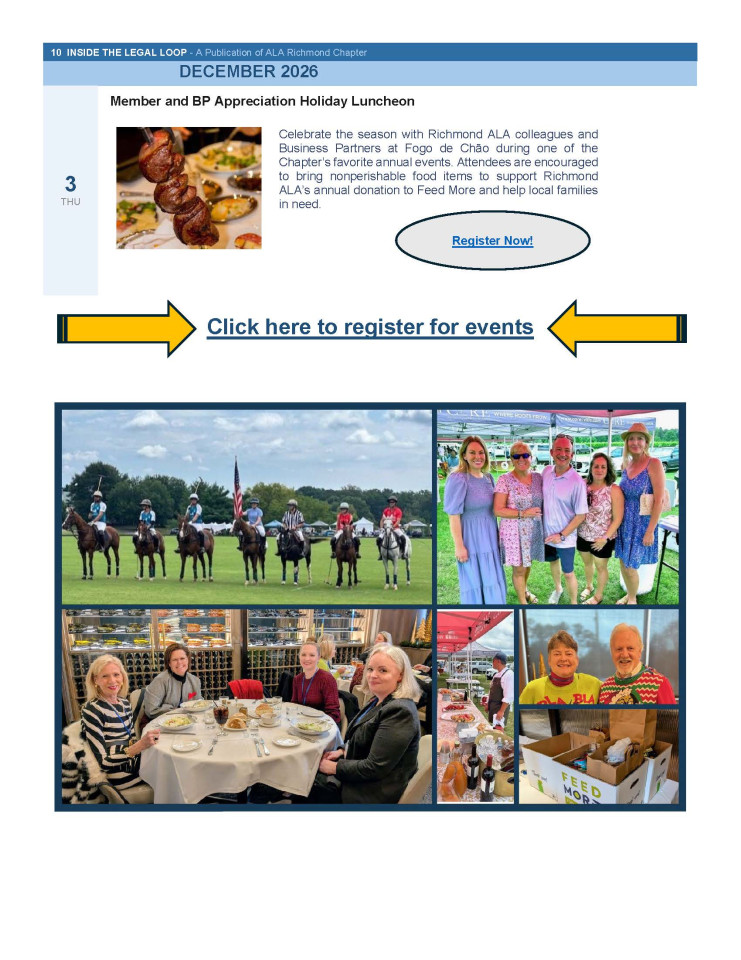
Join fellow RALA members for an evening of connections, conversation, and a little fun at The Park RVA, Richmond’s premier entertainment destination in Scott’s Addition. With interactive games, indoor and outdoor attractions, great food and drinks, and plenty of space to mingle, The Park is the perfect backdrop for building new relationships and reconnecting with familiar faces.


The Park  ·  5:00 pm

Sponsored by  Beacon Hill Legal  ·  Pinnacle Financial Partners  ·  Konica Minolta  ·  Afinety

REGISTER TODAY!


NO MEMBER MEETING IN AUGUST

⇒ CLICK HERE TO REGISTER FOR ALL CHAPTER EVENTS ⇐


Back to top

Columns & Feature Articles

Editorial note:  As Richmond firms increasingly field questions about AI adoption, legal administrators are the ones being asked to make it work. This article puts the conversation in terms we can actually use.

Different Machine, Same Anxiety: What AI Actually Means for Legal Administrators

As legal administrators are pushed further to adopt AI, it’s crucial to know how it can impact and ideally improve workloads.

By Todd Miller, April 2026

In the early days of the industrial revolution, frustrated workers took a very direct approach to technological change: They threw their wooden shoes — sabot — into the gears of the machines that threatened their livelihoods. Hence, the word “sabotage.”

Footwear has evolved since the 19th century. Human nature, less so. Today, at the outset of what many are calling the fifth industrial revolution, we’re seeing a familiar pattern: New machines arrive and productivity promises follow, but so does anxiety.

For legal administrators, HR directors and operations professionals — the people responsible for keeping a law firm running — the question is slightly different, and more honest: Is this going to make my job easier or just give me one more thing to manage?

It’s a fair question. And if history is any guide, it’s also the right one.

The Problem Isn’t New Technology. It’s Old Experience.

Legal administrators have been here before.

Every few years, a new system arrives with the promise of transformation. CRM platforms that will “unlock relationships.” Marketing tools that will “drive engagement.” Event systems that will “streamline operations.”

The rollout begins with enthusiasm. It ends, more often than not, with workarounds. Data becomes stale, adoption lags and reporting requires manual intervention. Lists are built in spreadsheets because it’s faster than navigating the system that was supposed to replace them.

And the burden of making it all function — quietly, persistently — falls on administrators. Not because the tools are inherently flawed, but because they were built on a premise that rarely holds in practice: that humans will consistently input, maintain and govern data at scale. They won’t, don’t and shouldn’t have to.

A Different Question

Much of the conversation around AI centers on what it might replace.

For legal administrators, a more useful question is what it might finally remove — not roles or responsibilities but friction. This is the kind of friction that accumulates over time:

  • Maintaining contact data that is outdated the moment it’s entered
  • Chasing attorneys for updates that never quite materialize
  • Building and rebuilding lists for every campaign
  • Reconciling conflicting sources of information
  • Translating activity into reports that leadership can actually use

These aren’t edge cases. They are the day-to-day realities of running the business side of a law firm.

If AI is to matter in this context, it won’t be because it sounds impressive but because it quietly eliminates these burdens.

What “Helpful” Actually Looks Like

There’s a tendency to think of AI in abstract terms — automation, prediction, intelligence. For administrators, usefulness is more concrete. A system is helpful if it does a few very specific things well.

  • It should be easy to deploy. Not a multi-month project or a cross-functional dependency exercise. Something that works without requiring a re-architecture of how the firm operates.
  • It should be intuitive to use. If a system requires training manuals or constant support, it has already failed the people it is supposed to help.
  • It should maintain its own data. This is where AI meaningfully changes the equation. When systems can capture, update and reconcile data automatically based on real activity rather than manual entry, the single greatest source of friction begins to disappear.
  • It should simplify core workflows. AI should not add steps but remove them. CRM should not be a database to maintain, but rather a system that reflects reality without constant intervention.
  • eMarketing should not require complicated list-building and should allow campaigns to be created and executed with confidence in the underlying data.
  • Event management should not involve stitching together tools and spreadsheets, but should operate as a cohesive, manageable process.
  • Pitches, presentations and marketing materials should not start from a blank page every time, but be generated, refined and delivered with minimal effort.

In each case, the goal is the same: Reduce the distance between intent and execution.

From Steward to Strategist

One of the less discussed aspects of administrative work is how much of it is consumed by maintenance: maintaining systems, data and processes that were supposed to be streamlined.

When that maintenance burden is reduced, something more interesting happens. Time is not just saved — it is reallocated. Instead of acting as stewards of systems, administrators have the opportunity to operate as strategic partners:

  • Identifying opportunities for growth rather than reconciling past activity
  • Supporting attorneys with timely, relevant information rather than chasing inputs
  • Driving initiatives rather than sustaining infrastructure

This is not a theoretical shift. It is a practical one, enabled by removing the underlying friction.

The Productivity Question

There is a narrative that AI will replace people. In the context of legal administration, a more immediate and observable effect is that it amplifies the people who are already there. The administrators who understand their firm’s operations, relationships and priorities are uniquely positioned to benefit if they are equipped with systems that work with them rather than against them.

The result is not redundancy but leverage that allows a team to operate with the effectiveness of a much larger one, makes responsiveness feel effortless and turns “How did you do that so quickly?” into a recurring question.

Choosing What to Embrace

The workers who threw their shoes into machines were not wrong to feel threatened. They were responding to real change, with incomplete information, in real time.

But history also tells us something else: The individuals and organizations that adapted to those changes were the ones who ultimately shaped what came next. The same dynamic is at play today.

AI will not be implemented in a vacuum. It will be selected, configured and operationalized by the very people who understand the day-to-day realities of running a firm. Which means the question is not whether AI will be part of the future of legal operations, it is who will define how it is used.

A Practical Path Forward

For legal administrators evaluating AI, the most useful approach is also the simplest: Focus less on what a system claims to be and more on what it actually removes.

  • Does it reduce manual work or shift it somewhere else?
  • Does it improve data quality automatically or depend on ongoing oversight?
  • Does it simplify execution or introduce new layers of process?

If the answer to those questions is clear, the decision often becomes clearer as well. The machines have changed and the anxiety feels familiar, but the opportunity is different.

This time, the most meaningful shift may not be in what work disappears but in how much easier the work that remains can become. And for the professionals who manage the business of law, that may be the most important change of all.

About the Author

Todd Miller

Back to top

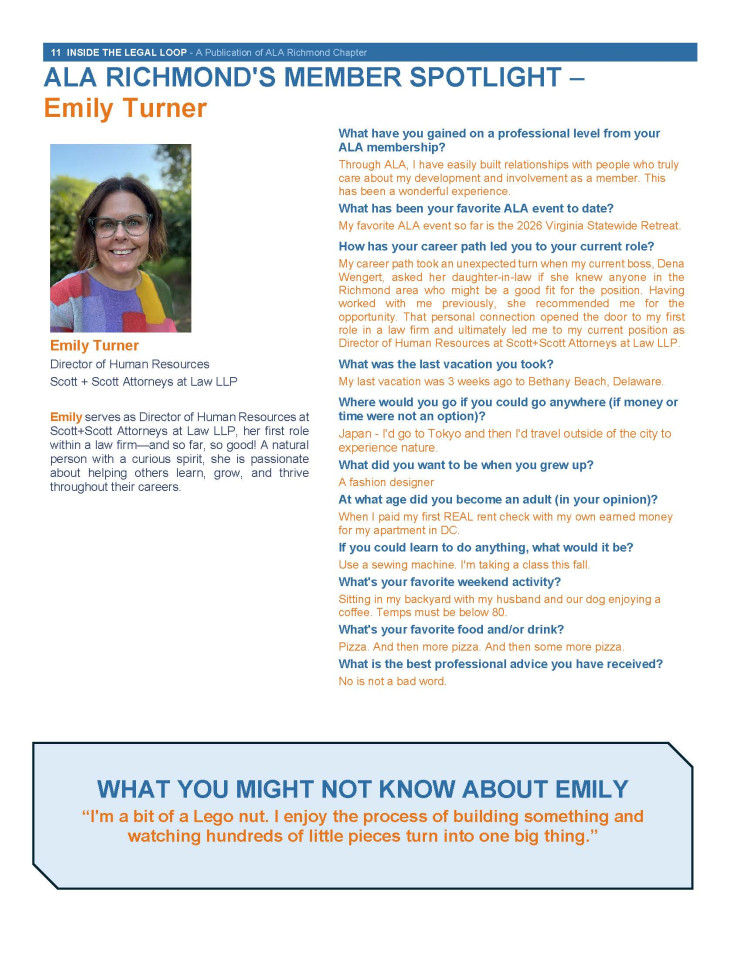
RALA Member Spotlight - Rebecca Hubbard


Firm Administrator
Timothy H. Guare, PLC

A Richmond native, Rebecca earned degrees in paralegal studies from J. Sargeant Reynolds Community College and the University of Richmond. She currently serves as both Firm Administrator and Fiduciary Administration Paralegal at Timothy H. Guare, PLC, a boutique solo firm focused on estate planning and estate and trust administration, where she plays a key role in both operational management and client service. Rebecca is also the Richmond Chapter’s new Treasurer for the 2026-2028 term.


What have you gained on a professional level from your ALA membership?

The former administrator at my firm was the one who suggested I join. She was right, as I have learned a great deal and have made many connections who are more than willing to help if I run into a problem. This knowledge and sense of community helped me transition into my administrator role.

What has been your favorite ALA event to date?

My favorite ALA event so far is the Virginia Statewide Retreat. It is always both enlightening and fun.

How has your career path led you to your current role?

I was trained to be a paralegal and worked in a couple of different areas of law. Then during Covid I joined my current firm as a paralegal. And when the longtime firm administrator retired, the owner decided to train me for the role rather than hire someone new.

What was the last vacation you took?

My last vacation was a trip down Skyline Drive. It is beautiful there in any season, but the fall leaves are especially gorgeous.

Where would you go if you could go anywhere (if money or time were not an option)?

If I could go anywhere with no time or financial constraints, I would have trouble picking between a trip to New Zealand or a long trip through Europe.

What did you want to be when you grew up?

What I wanted to be when I grew up shifted a lot – veterinarian, astronaut, Olympic athlete, President of the US…and of course Jedi knight. Ironically, at one point my parents thought I would be lawyer as I could argue my point with the tenacity of a bulldog.

What's your favorite TV show?

It’s hard to pick just one favorite TV show. I like a variety. A couple of recent ones I’ve especially enjoyed are The Mandalorian and The Gilded Age. I also enjoy some older shows such as Columbo, Big Bang Theory, and Downton Abbey, among others.

What is the best professional advice you have received?

I think the golden rule of “do unto others as you would have them do unto you” and “whatever you do … do it as unto the Lord” are good principles to strive to follow at work as well as in other areas of life.


Back to top

SILVER BUSINESS PARTNER SPOTLILGHT - Karlee Yonowitz


Client Executive

With 15 years in the legal industry, I’m passionate about building strong, lasting relationships and helping firms work smarter. I thrive on partnering with others across the industry to simplify legal IT and create better outcomes together. My philosophy is simple: good people want to work with good people, and that’s exactly how I approach every partnership. Outside of work, I love hanging out with my husband and two little kids, spending time at the beach, playing golf (love/hate relationship with the sport) and watching football (go dawgs!).

MEET KARLEE YONOWITZ - ONE OF OUR SILVER SPONSOR!


How long have you been involved with ALA Richmond?

I have been involved with Richmond ALA for about a year and it has been a joy getting to know everyone. Really looking forward to another year of helping the chapter grow and building more friendships.

What is the last vacation you took?
Puerto Rico - highly recommend!

What is your favorite weekend activity?
Going to the beach with a good book

What is your favorite way to pass 30 minutes of free time?
Taking a walk on a beautiful, sunny day.

If you could learn to do anything, what would it be?
Fly so I could travel the world!

What's your favorite food and/or drink?
I'm a Maryland girl, love crabs!

See how Afinety can help you at www.afinety.com or reach out to Karlee at [email protected]

For more than three decades, Afinety has partnered with small and midsize law firms to design, secure and manage the technology that keeps matters moving.

They know legal applications, client requirements and daily pressures because they built their business around them. From case preparation to billing and courtroom work, they make sure your technology supports your practice without getting in the way.

As a Netgain company, Afinety combines deep legal IT expertise with the scale, security and resources of a national managed services provider so firms get specialized support backed by enterprise-grade infrastructure.


Back to top

Columns & Feature Articles

Editorial note:  Few topics generate more debate in legal management right now than billing models. As AI compresses the time it takes to complete work, this question is moving from theoretical to urgent.

The Future of the Billable Hour

Increasing use of AI can lead to a potential drop in hands-on time spent on casework. Are billable hours still the best method for charging clients?

By Alex Heshmaty, February 2026

The roots of the billable hour in law firms go back to the early 1900s when young lawyer Reginald Heber Smith was working at the Boston Legal Aid Society.

In an effort to reduce inefficiencies and improve access to justice, after consultation with Harvard Business School, he successfully applied a variety of new recordkeeping and management techniques to the Society, resulting in 65% more legal aid cases being cleared. When he became managing partner at local firm Hale and Dorr in 1919, he implemented various new management techniques, such as timesheets, with the aim of improving efficiency. Although initially designed as a form of recordkeeping, timesheets gave rise to the new fee structure known as the billable hour, which Smith outlined in a book called Law Office Organization, published in 1940.

In the following decades, his method became the dominant fee structure for law firms across the world, usurping fixed fees, and took on a force of its own with the rise of the bonus culture in the 1980s. This structure led to billing targets, which have often been accused of causing stress and burnout among junior lawyers.

In recent years, there has been talk of a move away from billable hours. Law firm administrators should consider the potential benefits and learn the associated challenges to determine whether shifting from billable hours will improve the lives and profits of lawyers.

Why Move Away From the Billable Hour?

Optimal fee structures for businesses are constantly being debated, but the hegemony of the billable hour in the legal sector has been particularly challenged over the last decade or so, for a variety of reasons including:

Commercial Pressures

Since the financial crash in 2008, many clients have been progressively tightening their belts and are less willing to keep an open checkbook pertaining to legal matters. They want more certainty when it comes to legal expenses and are increasingly drawn toward the concept of fixed fees to help them plan ahead.

Unbundling of Legal Services

Modern clients tend to be much more savvy about the specific components of legal service they require and the variety of companies (not just law firms) that can fulfill their legal needs. For example, they will be aware that it is possible to obtain a template contract from an online store for a fraction of the cost that a lawyer would charge and will therefore often manage this themselves, possibly asking their lawyer to only handle contractual negotiations or disputes as and when they arise.

This heightened awareness of an increasing range of "unbundled" legal service options means that clients will often want a clearer idea of precisely which legal service components a law firm is charging them for and exactly how much they will need to pay.

Mental Health

The scourge of stress and burnout as a result of extremely challenging billing targets, particularly among junior lawyers, has been receiving increased attention over recent years. In general, law firms are more aware of their responsibilities as employers to protect the mental health of their staff. Although a move away from billable hours to fixed fees may not necessarily reduce the pressure on junior lawyers in and of itself, focusing more on outcomes rather than hours worked can potentially provide a healthier way of working.

Technology

As capital expenditure on technology solutions trends upwards, law firm administrators are increasingly under pressure to justify this spend. Products such as generative artificial intelligence (GenAI) promise enhanced efficiency but often come with a hefty price tag. There is a dilemma here when it comes to the billable hour: If money is being invested in technology, which reduces the time spent on a matter, and therefore results in lower fees (because fewer hours have been billed), is this actually a bad investment?

One answer may be to switch to fixed fees to reap rewards for efficiency gains. Another possibility is to take on more work from more clients and complete it faster. What is certain is that clients are fully aware of the debate around the use of GenAI in law firms and will sometimes demand that legal fees are reduced because they know that it will take less time to complete a matter using AI.

Types of Alternative Fee Arrangements

There are various ways in which a fee structure can be changed, but some of the more common types of alternative fee arrangements (AFAs) include:

  • Fixed fees: Also known as "flat fees," this is perhaps the most obvious type of AFA. It involves estimating the amount of time a certain piece of legal work will take to complete and fixing the cost at the outset. The advantage is that both parties are on the same page in relation to expectations, and there are no unwelcome surprises for the client when they receive their final bill. However, this is only suitable where the workload is unlikely to significantly change during the course of the matter being completed.
  • Capped fees: Under this form of AFA, legal services are billed on an hourly basis up to a certain amount or cap. If the work requires fewer hours than this capped figure, the client is billed according to the number of hours completed, but if it goes beyond this cap the law firm must absorb the cost.
  • Blended fees: With blended fees, the client pays a single hourly rate, irrespective of the seniority of the lawyer who carries out their work.
  • Contingency fees: Contingency fees are often used in personal injury claims where clients do not pay any fees unless their claim is successful, at which point the law firm deducts a percentage of compensation to cover their fees.

Other "value-based" billing arrangements include retainers, subscription fees, volume discounts and hybrid models.

Challenges of Switching From the Billable Hour to an AFA

One of the key problems with a move away from billable hours to an AFA is that it's not suitable for open-ended legal work, such as litigation, where time required cannot be estimated with any degree of accuracy. According to Brian Inkster, founder and Chief Executive Officer of Inksters, "The billable hour lends itself to more complex types of work where it is difficult to know what will ultimately be involved." He says that, although advocates of fixed fees or "value pricing" will say that you can scope each section of the work involved, this is "easier said than done for lawyers not trained in such skills."

Another issue is that flat fees could lead to work being rushed, especially where time pressures are placed on lawyers to minimize time spent in order to increase profits. On this point, Filippo Falchi, managing director at Major, Lindsey & Africa, notes that, from a client's point of view, "the billable hour helps ensure that lawyers will devote all the time needed to a given file, lessening the risk of cutting corners to save time."

Conversely, allowing too much time to be spent on fixed fee work could damage the profits of the firm. Inkster says that the main challenge for law firms that adopt fixed fees is" ensuring that they are not undercharging as a result." A balance will always need to be struck. Falchi says that firms "catering to smaller start-up clients, which might have tighter or more variable budgets, have successfully shifted away from the billable hour model," but for upper mid-market and large-cap players, "the billable hour model seems to continue being the flavor of choice."

There is also the administrative work that needs to be carried out to make a transition to a new system of billing clients, as well as any associated training and a potential cost of purchasing new billing software.

Last but not least, there may be resistance from law firms in a move away from billable hours. Falchi points out that the incumbent fee structure" could be seen as effectively incentivizing less than-optimal use of time: the longer a matter takes, the higher the legal bill." But Inkster argues that the "story spun that the billable hour encourages lawyers to spend more time on a case than they would necessarily need to is a fallacy."

Fee Structures and Mental Health

The billable hour fee structure and the associated billing targets have often been blamed for causing stress and burnout among lawyers, particularly those at an earlier stage of their careers. A report by Lawcare, a mental health charity focused on the legal sector in the U.K., indicated that nearly 60% of lawyers have poor mental wellbeing, with the 26-35 age group most affected. This is not a new phenomenon, with studies from the 1990s also finding similar issues with stress among young lawyers, caused in part by billing targets.

However, although there is an argument that focusing more on outcomes than hours billed is generally a healthier approach, there is no proof that moving away from billable hours to other fee structures reduces stress or prevents burnout. Ultimately, it comes down to the expectations placed upon them by management. Inkster argues that a shift to fixed fees "could increase stress if lawyers end up doing more work for less fees, which is likely if they don't scope the work properly." Similarly, Falchi does not believe that AFAs would bring about positive change from the standpoint of mental health, arguing that it could actually "bring about a negative change for associates' mental health" due to the increased focus on productivity and output.

Predictions on the Fate of the Billable Hour

The death of the billable hour has been predicted for at least the past couple of decades, and yet it is still the most widely used fee structure in the legal industry. However, the pendulum does appear to be shifting back toward the era of fixed fees, which was prevalent before Reginald Heber Smith shook things up.

According to a study by Thomson Reuters, 64% of corporate legal teams and 58% of law firms anticipate a reduction in the reliance on hourly billing by 2030. Nevertheless, Inkster predicts that the billable hour will still be the primary fee structure in law firms in 10 years' time, at least "for the areas of work where it is predominantly used at the moment." He notes that the end of the billable hour has been predicted "for many 10-year cycles before this one with no real change."

As technology disrupts the legal sector and unbundling particular components of legal work and automating them becomes more prevalent, clients will increasingly demand more certainty over pricing, so AFAs will likely become more popular. However, legal services that cannot be easily measured, such as ongoing litigation, will almost certainly keep the billable hour alive.

"Firms and clients have been announcing the death of the billable hour for decades," Falchi says, but despite all the talk, "little progress has been made." Ultimately, firms will likely continue to see a mixture of the billable hour and AFAs, depending on the type of work and the impact of technology.

Some firms will continue to solely rely on billable hours whereas others will abandon it altogether. A close eye will also need to be kept on legal technology development, as this could impact the viability of both fee structures and levels of fee. But the legacy of Reginald Heber Smith is unlikely to be forgotten any time soon.


Back to top

Columns & Feature Articles

Standing Out Without a Degree: How the CLM Elevates Your Career

Katie J. Bryant, CLM, shares how becoming a Certified Legal Manager can show firms you have the skills to be a leader.

By Katie Bryant, CLM

In today’s legal industry, credentials matter. For many law firm administrators, the lack of a college degree can feel like an invisible ceiling — one that limits opportunities for advancement or keeps them overlooked in the hiring process. But there is a credential designed specifically to shatter that ceiling: the Certified Legal Manager (CLM®) designation.

Breaking Through Barriers

The CLM proves what experience alone cannot always convey: that you possess the full spectrum of skills — financial management, operations, human resources, risk and strategic leadership — required to manage a law firm at the highest level. Hiring committees and managing partners may not always know how to measure the depth of your expertise, but when they see the CLM, they know instantly: This candidate has been tested, vetted and recognized by the Association of Legal Administrators as a leader in the field.

Competing With Degrees

In many professions, advanced degrees act as shorthand for credibility. The CLM offers administrators the same shorthand within the legal industry. Instead of asking, “Do you have a degree?” the question becomes, “Do you have the CLM?” Earning the designation signals not just knowledge, but discipline, resilience and commitment to ongoing professional growth. That’s the kind of credibility that resonates in interviews, performance reviews and succession planning conversations.

Unlocking Promotions and Pay Potential

Firms are businesses. They reward measurable value. When you pursue the CLM, you bring back tangible improvements to profitability, efficiency and compliance. That makes you more than an administrator; you become a strategic partner in the firm’s success. And firms notice. Many CLMs report that earning the credential led directly to raises, promotions or expanded responsibilities because the value they added became undeniable.

Your Next Step Forward

The CLM is proof that the path to leadership doesn’t have to follow the traditional road of higher education. It creates a new path, one built on competence, credibility and confidence. Whether you’re competing for a new position, negotiating a raise or simply wanting to command more respect within your firm, the CLM is the credential that sets you apart.

Visit https://www.alanet.org/certification to get started on your journey to the CLM.

Back to top

ALA's Certified Legal Manager (CLM)

Become a Certified Legal Manager

As the legal services industry becomes more diverse and competitive, the need for capable managers has never been greater. That’s why earning the Certified Legal Manager (CLM)® credential — regardless of the stage in your career — shows your commitment to staying on top of the legal management profession.

It’s not an easy credential to earn — but that’s the point. The CLM credential demonstrates to your firm that you’ve mastered the knowledge, skills and abilities to operate at a high level of expertise in the field of legal management. In fact, those who pass the CLM exam have the depth and breadth of knowledge and management skills that enables them to visit any 30- to 50-attorney law office, review practices and procedures, and be conversant about — and offer advice in — each of the areas listed in the Body of Knowledge.

ALA is the exclusive credentialing body of the CLM program, and CLM Certification is offered twice a year — in the Spring and the Fall.

First Steps to Certification 

·       Read the application and education requirements: Congratulations! You’ve made the decision to take the CLM exam. Here’s what you need to know about the application requirements. This details employment and education criteria.

·       Sign the ALA Code of Ethics: Now that you’ve met the application requirements, read and sign the ALA Code of Ethics. ALL CLMs must sign and adhere to these principles.

·       Submit your application: Our online application walks you through all the steps outlined in our application and education requirements.

·       Purchase the CLM Study Guide: The best way to prep! The study guide was designed to help you prepare effectively to earn your CLM. ALA members get a discount on the cost. 

Key CLM Dates for 2026

Fall 2026

  • Application deadline: September 4
  • Test dates: November 2-25

In recognition of the value and benefits of the CLM designation, the Richmond Chapter will provide reimbursement in the amount up to $500 for its members who pass the CLM exam.

Reach out to Abby Davis-Hess, CLM for more information on this opportunity!

Contact: [email protected]


Back to top

Chapter Education

   Click here for more information


Virtual Events:

 Click here for more details         

Online Events:

Did you know what you can find??

·       Board Meeting Minutes

·       Member Meeting Minutes

·       Meeting Handouts

·       Discussion Boards

·       CLM Certification Information


Back to top

That's A Wrap!

THAT’S A WRAP — ALA Richmond Midyear Review

A look back at the first half of 2026

MEMBER MEETINGS — JANUARY THROUGH MAY 2026

JAN

Year-End Compliance Checklist

Ashley Smartt, Dominion Payroll

Sponsored by
 

This hybrid meeting featured Ashley Smartt, Director of People and HR Services at Dominion Payroll, who provided practical guidance on navigating 2026 HR and payroll requirements. The session delivered valuable insights on compliance, reporting deadlines, and strategic planning, equipping attendees with tools to streamline processes and avoid costly missteps in the year ahead.

KEY TAKEAWAYS

 Stay ahead of deadlines: W-2s, ACA reporting, OSHA logs, and contractor filings require early preparation

  • Watch regulatory changes: Minimum wage increases, pay transparency laws, and worker classification rules demand immediate attention
  • Audit early: Year-end I-9 audits, payroll reconciliation, and benefits accuracy are essential to avoid penalties
  • Update your policies: Handbooks, PTO policies, and compensation structures should reflect new laws for 2026
  • Plan strategically: Focus on retention, workforce planning, and clear remote/hybrid policies to stay competitive

FEB

Change Agent Power

Emily Krause, Amped Up Marketing

Sponsored by 


In February, members attended a session featuring Emily Krause, Founder and President of Amped Up Marketing, who shared practical strategies for leading through change in today’s evolving legal environment. Drawing on more than 25 years of experience, she provided actionable guidance on driving organizational change, building influence, and gaining stakeholder buy-in—equipping attendees to approach change with confidence and use it as a catalyst for growth.

KEY TAKEAWAYS

 Embrace change as opportunity: Shifting client expectations and workplace dynamics can be leveraged for growth and innovation

  • Follow a structured approach: Six core principles provide a roadmap for implementing sustainable organizational change
  • Build influence intentionally: Effective change leadership requires strong communication, credibility, and relationship-building
  • Gain stakeholder buy-in: Success in tradition-driven environments depends on engaging key stakeholders early and often

MAR

Cybersecurity Update

Bill Sorenson, Afinety

Sponsored by

The March member meeting featured Bill Sorenson of Afinety, who delivered a practical, business-focused discussion on cybersecurity in today’s law firm environment. The session highlighted cybersecurity as a critical leadership issue—exploring regulatory requirements, insurance implications, and real-world risks—while equipping attendees with a clear framework to assess vulnerabilities, strengthen policies, and build firm-wide resilience.

KEY TAKEAWAYS

  •  Cybersecurity is a leadership issue: Data breaches impact operations, client trust, and financial stability
  • Know the regulatory landscape: ABA guidance, FTC Safeguards, IRS 4557, and HIPAA shape firm policies
  • Insurance and compliance are linked: Align cybersecurity practices with insurance requirements to avoid coverage gaps
  • Adopt a three-phase strategy: Assess risk, strengthen policies, and build firm-wide awareness to improve resilience


APR

Professionalism for the Unprofessionals

Elise Powers, Eleview Consulting

Sponsored by


Elise Powers of Eleview Consulting recently led an online session, focused on navigating conversations around workplace expectations and etiquette with early-career professionals. Drawing on extensive research and real-world experience, the session provided practical strategies for clearly communicating standards related to communication, professionalism, and workplace behavior. Attendees left with actionable tools to guide new attorneys, reduce ambiguity, and foster a more polished, productive firm culture

KEY TAKEAWAYS

 Set clear expectations early: Define professional standards to eliminate confusion and build trust

  • Address etiquette proactively: Tackle topics like email, dress, and formality in a direct but approachable way
  • Use data-driven insights: Leverage trends in workplace behavior to guide coaching conversations
  • Communicate without discomfort: Frame feedback to avoid defensiveness and encourage growth
  • Equip leaders to coach effectively: Provide practical tools to help supervisors develop strong interpersonal skills in young professionals

MAY


De-Escalating Touchy Situations

Abigail Davis-Hess, ADH-Consulting, LLS & Jennifer Hobson, Williams Mullen

Sponsored by 

Members recently attended a Supervisors Toolbox session led by Abigail Davis-Hess and Jennifer Hobson, which reframed de-escalation as a critical leadership skill rather than a reactive measure. The session focused on the supervisor’s role as a “team regulator,” emphasizing how emotional intelligence, awareness of burnout, and real-time communication strategies can shift tense situations into productive dialogue. Attendees gained practical tools to reduce conflict, restore psychological safety, and foster stronger, more collaborative team environments.

KEY TAKEAWAYS

  • Burnout is widespread: driven by workload, staffing gaps, and “hero” culture; early warning signs are often missed. De-escalation training benefits all employees and strengthens compassion and active listening.
  • De-escalation is a core leadership skill: not just for conflict, but for daily team regulation that supports psychological safety and collaboration.
  • You can’t reason with a threatened brain: Reducing perceived threat is essential to re-engage logic and communication
  • Emotion before logic: when people feel threatened, reasoning fails—effective leaders first reduce perceived threat, then address issues using emotional intelligence in real time.
  • Focus on root causes and prevention, not just reactions: escalation often reflects burnout and stress; proactive tools and consistent practices help reduce conflict and improve long-term team dynamics.


RALA Patio Season Kick Off – Main Line Brewery

 
RALA members gathered at Main Line Brewery to kick off the Summer Patio Series with an evening of networking, live music, and community connection. The event provided a welcome opportunity for legal industry professionals to step away from their busy schedules, reconnect with colleagues and friends, and enjoy one of Richmond's favorite local venues in a relaxed outdoor setting. A special thank you to Abby Baker and Beacon Hill Legal for sponsoring the event and helping make the evening a success.

 Sponsored by


Back to top

Virginia Statewide Conference

2026 ALA Virginia Statewide Retreat

The Main, Norfolk

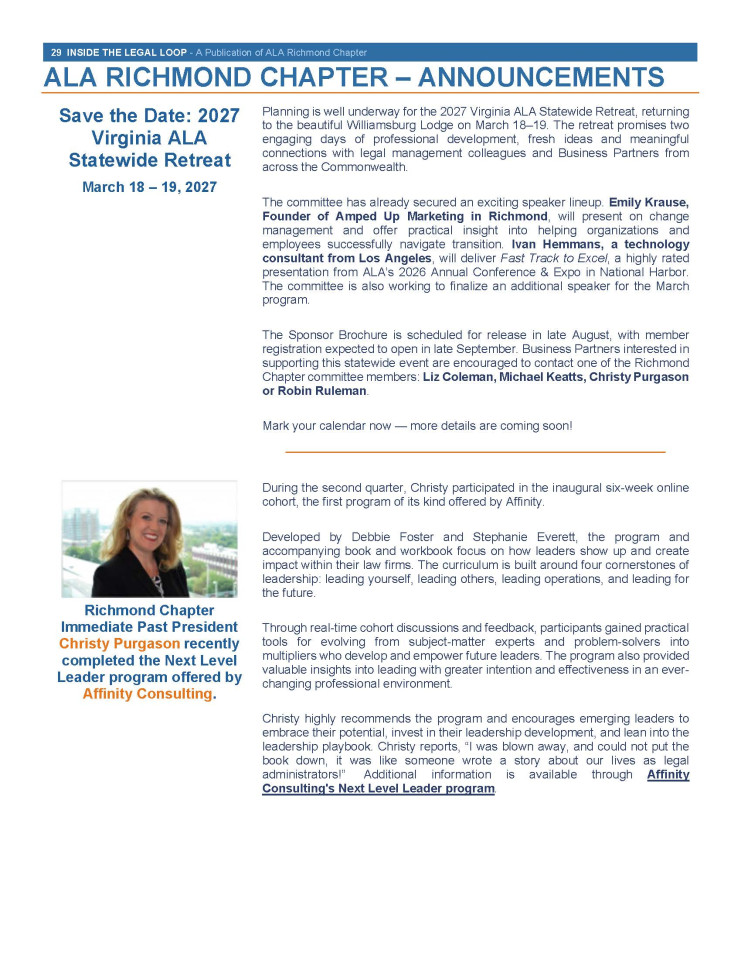
The 2026 Virginia Association of Legal Administrators (ALA) Statewide Retreat, held March 5–6 at The Main in Norfolk, brought together legal management professionals from across the Commonwealth for two days of learning, collaboration, and forward-looking discussion. With representation from the Richmond, Hampton Roads, Northern Virginia, and Western Virginia chapters, the retreat fostered a strong statewide exchange of ideas, with perspectives from both large metropolitan firms and smaller regional practices enriching the conversation and reinforcing shared challenges and opportunities across the profession.

Educational sessions focused on the most pressing issues in today’s legal environment, beginning with a powerful presentation by Jacob Wright of the Norfolk Sheriff's Office. His session on workplace violence preparedness emphasized that awareness and preparation are critical to saving lives. Grounded in current data and real-world trends, he introduced the “Run, Hide, Fight” framework while helping participants recognize early warning signs and develop effective emergency action plans. The importance of regularly practicing response scenarios reinforced a key takeaway: preparedness must be proactive, not reactive.

Technology and innovation were also front and center, with Spencer Smith of Spencer X. Smith Consulting offering a clear and practical introduction to artificial intelligence in legal administration. His session demonstrated how AI can enhance—rather than replace—professional expertise by improving workflows, increasing efficiency, and producing more accurate results through effective prompting. Attendees left with actionable strategies, real-world examples, and a better understanding of how to use AI securely and responsibly in their day-to-day roles.

The importance of leadership and workplace culture was explored by Dr. Tomika Ferguson of Virginia Commonwealth University, who emphasized that innovation and strong performance are rooted in psychological safety and intentional, relational leadership. Her session highlighted how inclusive cultures are built through everyday interactions—where individuals feel safe to contribute, take risks, and engage openly. By strengthening communication, trust, and awareness of team dynamics, leaders can foster environments that drive engagement, retention, and results.

Rounding out the program, George Koliopoulos, J.D. of Williams Mullen delivered a practical roadmap for conducting workplace investigations. His session focused on responding to allegations effectively while minimizing legal risk, covering key legal considerations, interview techniques, and best practices for maintaining objectivity and thorough documentation. Through real-world examples, attendees gained confidence in navigating sensitive situations and avoiding common missteps.

The 2026 Statewide Retreat served as a powerful reminder of how quickly the legal management landscape is evolving—and how essential it is for administrators to stay informed, connected, and adaptable. As attendees returned to their firms, they carried with them not only new ideas and practical tools but also strengthened relationships that will continue to support collaboration across Virginia’s ALA community.


Back to top

ALA Regional Conferences

2026 ALA Annual Conference & Expo

National Harbor, Maryland, April 2026


Members of the Richmond ALA chapter recently attended the Association of Legal Administrators (ALA) Annual Conference & Expo, held April 12–16 at Gaylord National Resort & Convention Center in National Harbor. This premier national event brought together legal management professionals from across the country for several days of dynamic learning, meaningful networking, and forward-looking discussion on the evolving role of legal administrators.

The conference featured an impressive lineup of keynote speakers. Opening keynote presenter Michelle Rozen delivered “The 6% Club: The Science of Peak Performance and the Daily Habits That Separate High Achieving Individuals, Leaders and Teams from the 94%,” offering insight into the behaviors and mindset that drive exceptional performance. The David W. Brezina Memorial Session welcomed J. R. Martinez, who shared a powerful message on resilience drawn from his experience as a U.S. Army soldier injured in Iraq. In a memorable moment, Richmond member Kathy Scourby joined him on stage to share her own story of resilience. Closing keynote speaker Heather McGowan provided a thoughtful perspective on navigating uncertainty, connecting personal experience with practical frameworks for leading through change.

Educational sessions throughout the conference addressed many of the most pressing issues facing today’s legal administrators, including artificial intelligence, effective communication and feedback, advanced Excel skills, writing for impact, and strategies for hiring and retention. Many sessions offered Continuing Legal Management (CLM) credit, supporting attendees pursuing certification or recertification. For those interested in becoming a Certified Legal Manager, ALA National offers study groups and training resources and can be contacted at [email protected] for additional information.

Beyond the sessions, the conference provided valuable opportunities to connect with peers, industry partners, and solution providers, reinforcing the strength of the ALA network on a national scale.

Representing the Richmond Chapter were Michelle Andino, Billie Jo Brooks, Abigail Davis-Hess, Mary Downey, Catherine Jacquemin, Michael Keatts, Kimberly King, Tiffany Pittman, Robin Ruleman, and Kathy Scourby.

The 2026 Annual Conference & Expo served as a powerful reminder of how quickly the legal management landscape is evolving—and how essential it is for administrators to stay informed, connected, and adaptable. Attendees returned with fresh ideas, practical tools, and strengthened professional relationships to support continued success within their firms and the broader ALA community.


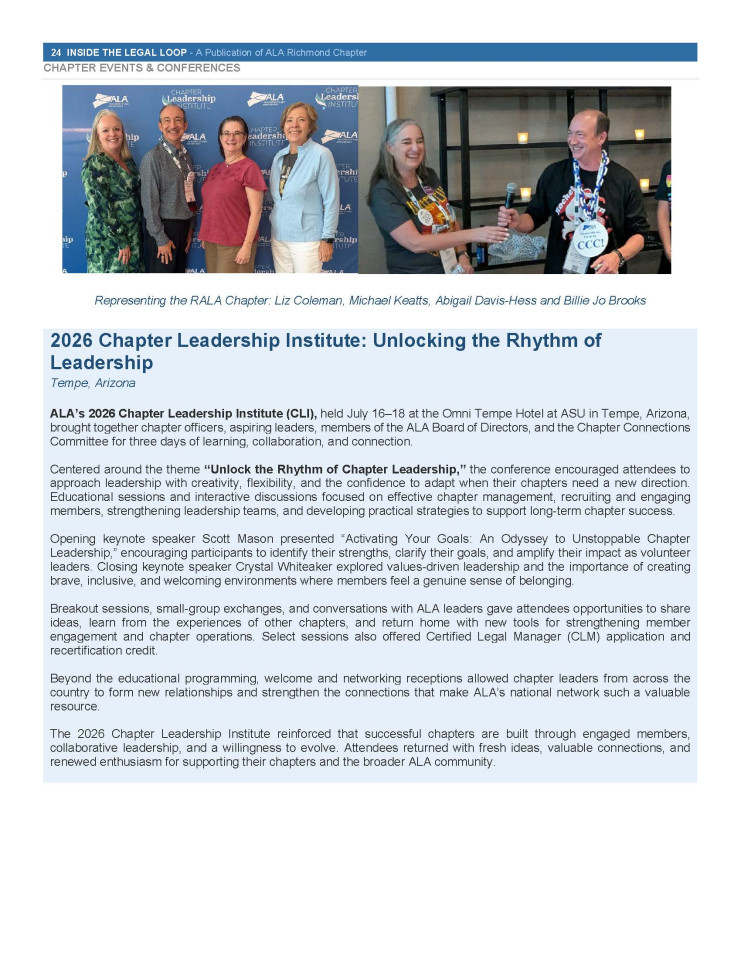
Back to top

Community Outreach - Tech4Troops

Tech 4 Troops — Richmond ALA Volunteer Day


Members of the Richmond ALA chapter recently partnered with Tech For Troops for a hands-on volunteer day supporting veterans and their families through technology access and digital skills. Founded in 2014, Tech for Troops is dedicated to empowering under-resourced veterans by refurbishing donated technology, providing training and education, and offering innovative programs—including a gaming initiative developed in collaboration with mental health professionals.

During the event, volunteers toured the facility and gained insight into daily operations before participating in a variety of activities such as breaking down computers, sorting and recycling components, cleaning laptops, and preparing devices for redistribution. These efforts directly support the organization’s mission to reduce electronic waste while equipping veterans with the tools and skills needed for long-term success. The day was both impactful and engaging, offering members a meaningful opportunity to give back to the community while working alongside fellow ALA members.


Back to top

Columns & Feature Articles

Editorial note:  Culture is critical to firm performance. In an environment shaped by uncertainty and change, legal administrators are increasingly responsible for creating the clarity, consistency, and psychological safety that drive resilience.

Resilience by Design: Building a Secure Work Culture That Lasts

ALA Executive Director Eryn Carter, CAE, discusses how to provide clarity, support and security for a strong firm environment.

By Eryn Carter, CAE, January 2026

When we talk about creating a strong work environment, the conversation often moves toward strategy, structure or systems. All are important, but none are sufficient on their own. At the core of every strong organization is something less tangible, yet far more powerful: a culture that is both secure enough to support people and resilient enough to adapt to constant change.

A few months ago, I spoke with an ALA member who was a senior leader during a tough time at her firm. The team faced economic pressure, changing priorities and burnout. She told me, “People seem disengaged, but I don’t know what more I can ask of them.” When she looked closer, the problem wasn’t about commitment or skill. It was uncertainty. People didn’t feel safe sharing concerns and weren’t confident in how decisions were made. Productivity dropped not because people didn’t care, but because the environment didn’t feel secure. This understanding showed her that resilience isn’t about asking people to push through more challenges; it’s about creating the right conditions so they can do their best, even when things are hard. 

Legal administrators often work in complex and high-pressure environments, which can challenge even the best organizations. A strong culture helps keep everyone grounded, so when problems come up, the firm responds with confidence instead of confusion. A secure culture gives employees clarity, trust and the resources they need to navigate uncertainty. When people feel safe, they perform their best. That sense of security is what transforms a group of individuals into a connected, high-performing team. 

A resilient culture begins with psychological safety. In a secure environment, people feel comfortable speaking up, asking questions, offering ideas, admitting mistakes and voicing issues early rather than waiting for problems to escalate. Legal administrators play a key role here. Often closer to the day-to-day operations of the firm, administrators are uniquely positioned to set the tone for how work gets done and how people experience the organization. When administrators model openness, curiosity and stability under pressure, they send a powerful message that the organization is a place where people are listened to and valued. 

Security is also rooted in clarity. Strong work environments stress clear communication about expectations, priorities and decision-making processes even when answers are still evolving. 

Legal administrators are often the translators of strategy into practice. They help connect leadership decisions to day-to-day realities, clarify roles and ensure teams understand not just the “what,” but the “why.” Saying, “Here’s what we know, here’s what we’re still working through and here’s how we’ll keep you informed,” helps reduce anxiety and build trust. Clarity, in this sense, becomes a form of care. 

According to the coaching and consulting firm Pure Symmetry, resilient cultures are built on trust, and trust is built through consistency. Employees pay close attention to whether values are consistent with everyday actions. Are policies applied fairly? Are processes transparent? Are leaders accessible and accountable? 

Legal administrators are often the stewards of that consistency. Through policies, procedures and regular communications, they reinforce what the firm truly stands for. Consistency does not mean rigidity. Resilient organizations are often flexible but also fair, principled and people-centered. This creates a sense of security that allows people to focus on meaningful work rather than navigating uncertainty. 

Some people think resilience just means “pushing through.” But keeping a strong work environment means organizations must keep investing in their people’s well-being, growth and long-term success. 

From workload management and professional development to benefits, policies and  training, administrators shape the systems that either support resilience or undermine it. Equipping administrators to lead with empathy and recognizing contributions and achievements are not soft practices — they are strategic ones. 

Creating a strong work environment is not a one-time initiative. Culture is shaped through regular experiences challenging leaders on how to respond under pressure, handle feedback and both define and celebrate success. 

Through their leadership, presence and influence, legal administrators create conditions that allow people to do their best work. In uncertain times, people look for stability, purpose and trust. Organizations that invest in secure, resilient cultures, guided by strong leadership at all levels, will not only weather change but also emerge stronger because of it. That’s the kind of strength that endures.

Back to top

Welcome New Members

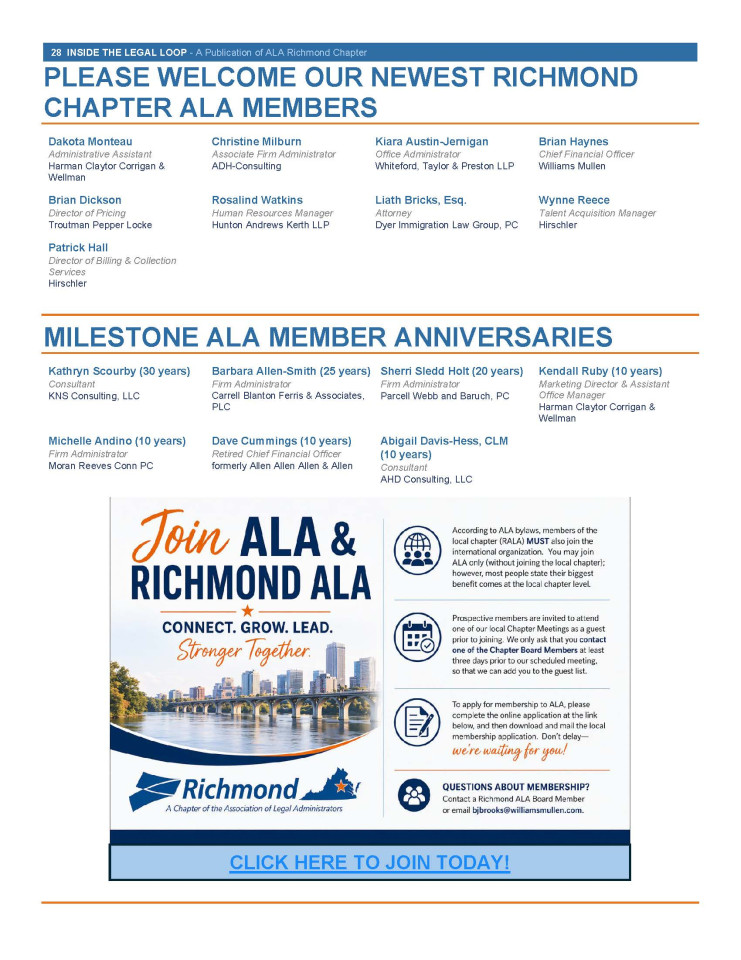
PLEASE WELCOME OUR NEWEST RICHMOND CHAPTER ALA MEMBERS

Dakota Monteau

Administrative Assistant

Harman Claytor Corrigan & Wellman

Christine Milburn

Associate Firm Administrator

ADH-Consulting

Kiara Austin-Jernigan

Office Administrator

Whiteford, Taylor & Preston LLP

Brian Haynes

Chief Financial Officer

Williams Mullen

Brian Dickson

Director of Pricing

Troutman Pepper Locke

Rosalind Watkins

Human Resources Manager

Hunton Andrews Kerth LLP

Liath Bricks, Esq.

Attorney

Dyer Immigration Law Group, PC


MILESTONE ALA MEMBER ANNIVERSARIES

Kathryn Scourby
(30 years)

Consultant

KNS Consulting, LLC

Barbara Allen-Smith
(25 years)

Firm Administrator

Carrell Blanton Ferris & Associates, PLC

Sherri Sledd Holt
(20 years)

Firm Administrator

Parcell Webb and Baruch, PC

Kendall Ruby
(10 years)

Marketing Director & Assistant Office Manager

Harman Claytor Corrigan & Wellman

Michelle Andino
(10 years)

Firm Administrator

Moran Reeves Conn PC

David Cummings
(10 years)

Retired Chief Financial Officer
formerly Allen Allen Allen & Allen

Abigail Davis-Hess, CLM
(10 years)

Consultant

AHD Consulting, LLC


CLICK HERE TO JOIN TODAY!


Back to top

Getting to Know Your RALA Board of Directors

When was the last time you did something for the first time?


Bille Jo Brooks, President

Traveled to Scotland in December. Loved it!.

Christine Purgason, Past President

In my spare time (haha) I am a seamstress. The last project that I tackled was taking my friends 1993 wedding dress, deconstructing it, and making a "getting ready for the wedding" robe for her daughter. The entire robe was from the wedding dress with certain aesthetics brought out from the original dress. A very fun and educational project!

Abby Davis-Hess, President-Elect

Camped in the Boundary Waters Canoe Area Wilderness

(BWCAW) last summer. Canoed 50 miles.

Rebecca Hubbard, Treasurer

My boyfriend recently introduced me to shawarma, and it was very tasty.

Jill Bryant, Secretary

Last August I attended Polo at King Family Vineyards in Crozet, VA - first time and so much fun!

Dave Cummings, Programs & Education Director

With the rest of the world, I have been amazed at some of the pictures sent back to earth from the Hubble Telescope ... with each picture, seeing for the first time another glimpse of the vastness of space and the evidence of the creative power that formed the universe.

Liz Coleman, VP Business Partners

Recently, I mentored someone in a completely different career stage than my own. It was the first time I realized how much I could learn from the process as well and it shifted how I think about leadership.

Rachel Bickford, Communications

This past spring I was Cookie Mom for my daughter's Girl Scout troop!

Danielle Dann, Communications

Over spring break with my kids, we went kayaking and swam with the manatees in the natural springs of Florida.

Michael Keatts, Statewide Retreat

As of Annual Conference in April, I am currently chairing ALA's Chapter Connections Committee

 (which is the first time I've chaired a committee at the international level).

Joe Loving, Community Connections

On 3/24/2026 we had our first child; I haven't been humbled this regularly in a LONG time.


Back to top

Member News & Annoucements


Congratulations to our ActionStep BP Partner and Community Relations Committee Co-Chair, Joe Loving, on the birth of his son on March 24, 2026.

Congratulations to Kathy Scourby on her appointment to the 2026-2027 Board of Trustees of the Foundation of ALA!!!

       
                  Congratulations to Michael Keatts who is now the new 2026-2027 Chair of the Chapter Connections Committee

Back to top

Thank you!

Thank you to all our

 Business Partner

Sponsors!!!


Back to top